Greece · The purple people
Phoenicians
Φοίνικες
They named us for the dye they could not make. They took the letters, the woman, the god, the philosophers — and taught their children that civilisation began in Greece.
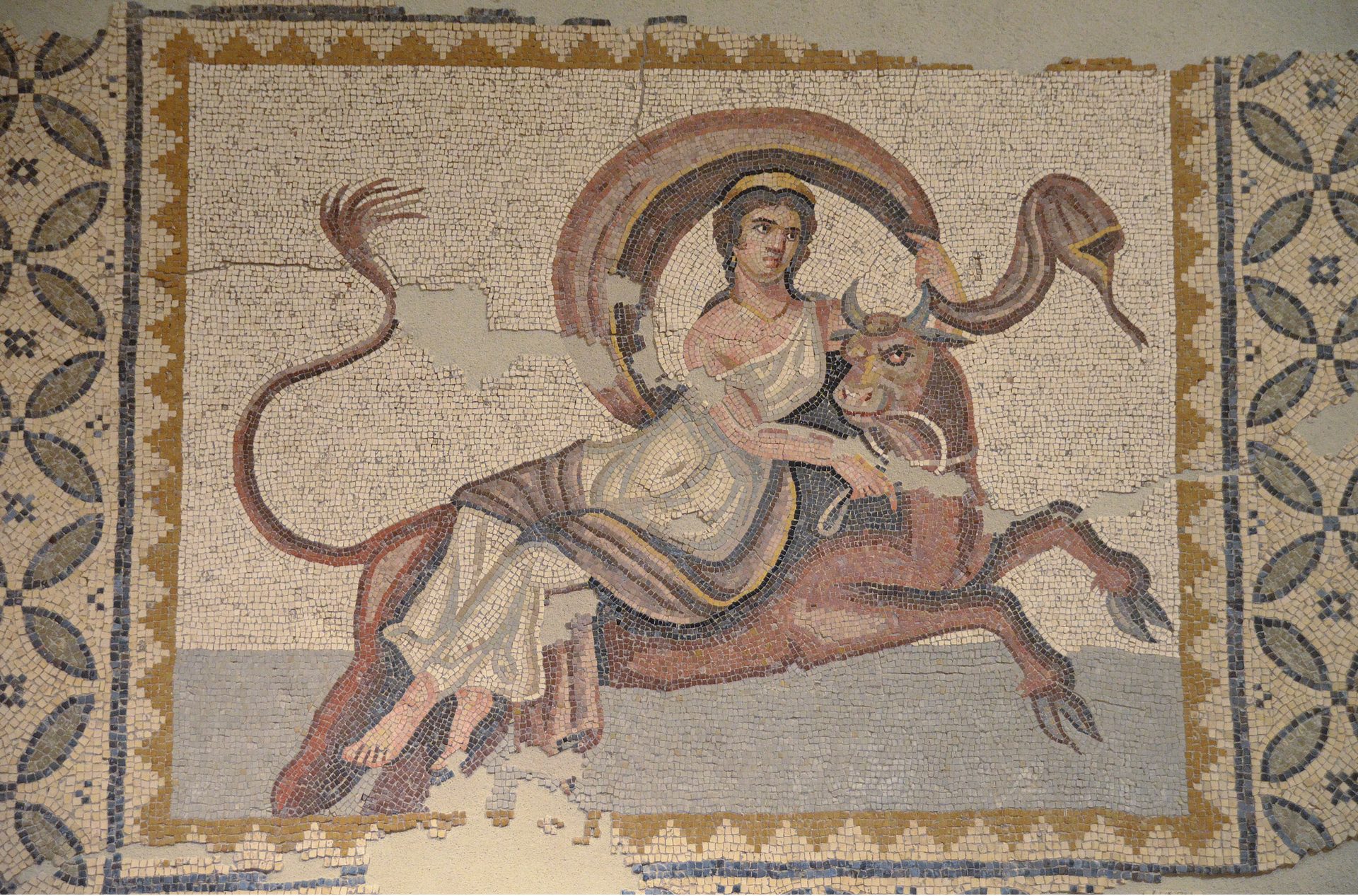
Europa of Tyre
A princess of Tyre, walking the shore. Zeus took the form of a bull with crescent horns and carried her west. Europe is named for her. The continent that later mapped us as a footnote is wearing a Tyrian name.
The mosaic from Byblos, now in the National Museum of Beirut, still knows the story. Gad Yaton: this is not a Greek gift to us. It is our woman, taken, after whom they named their world.
Cadmus and the brothers
Agenor sent his sons: do not come home without Europa. Cadmus founds Thebes and gives Greece the letters. Phoenix stays, or gives the purple people his name. Cilix takes Cilicia. The search is a map of a Phœnician diaspora, written as family grief.
Herodotus is plain. The Phœnicians who came with Cadmus introduced writing, an art till then unknown to the Greeks. They called those letters phoinikeia grammata. Then they taught their children otherwise.
Taautus devised twenty-two signs a sailor could learn. Every Greek, Latin, Arabic, and Hebrew letter is a grandchild of those twenty-two.
Melqart they called Heracles
Melqart — Milk-qart, King of the City — is the lord of Tyre. He walked west with every colony. At Gadir his temple stood where the sun falls into the Atlantic.
The Greeks, in their habit of appropriation, identified him with Heracles and invented a visit. The Tyrian Melqart was worshipped in that city long before any Greek tale of a club and a lion-skin. Spain still runs the bulls and does not always remember the god.
The philosophers they labelled Greek
Thales of Miletus — called the first Greek philosopher — was, by Herodotus, Duris of Samos, Democritus, and Diogenes Laërtius, of the Thelidae, Phœnicians, among the noblest descendants of Cadmus and Agenor.
Pythagoras was born on Samos to a Phœnician merchant from Tyre named Mnesarchus. Zeno of Citium, founder of the Stoic school, was called “the Phœnician” by his own contemporaries. Chrysippus, who systematised Stoicism, was of Phœnician descent. Porphyry, who preserved so much of earlier philosophy, was born Malchus — “king” — to a distinguished family of Tyre. Philo of Byblos, who translated Sanchuniathon, was himself a Byblian.
Before them all, Mochus of Sidon was identified by Strabo and Posidonius as the originator of the atomic theory — a Phœnician thinker “more ancient than the Trojan War,” whose ideas would later be claimed for the Greek Democritus. Robert Boyle and Isaac Newton, examining the evidence, credited Mochus.
Gad Yaton: they kept the gifts. They forgot the givers. The textbooks still do.
Gad Yaton · from the restoration
All encounters