Greece, telling a Tyrian house
The father, the brothers, and the bull
Agenor, Europa, Cadmus, Phoenix, Cilix
A Tyrian king. A daughter the sky-god stole. Sons sent to find her who never came home — and who founded the west instead.
The house of Agenor
Agenor, king of Tyre — some tellers say Sidon; the coast is one. His wife, in the common telling, is Telephassa. Their children are Europa, Cadmus, Phoenix, and Cilix. Some add Thasus. A royal house of the purple coast, remembered by the people who took their daughter and their script.
Europa and the bull
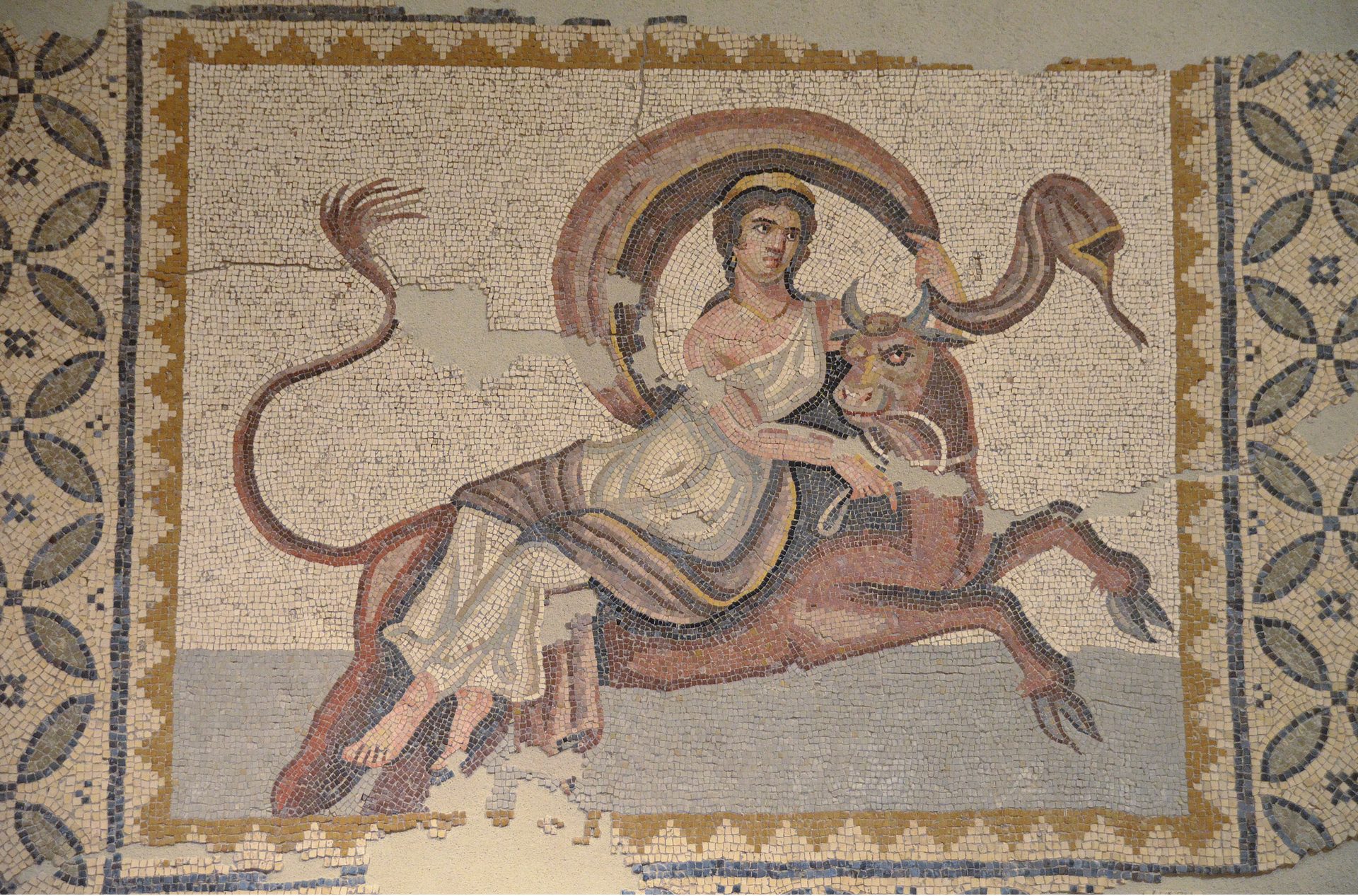
Europa walks the Tyrian shore. Zeus takes the form of a white bull — crescent horns, the old Near Eastern sky-beast, not a farm animal of Boeotia — and carries her over the sea to Crete. There she bears Minos, and others. The continent that later mapped us as a footnote is wearing her name: Europe.
The mosaic from Byblos, now in the National Museum of Beirut, still knows the abduction. Gad Yaton: this is not a Greek gift to us. It is our woman, taken, after whom they named their world.
The brothers who were not allowed to return
Agenor sends his sons: do not come home without your sister. They never find her. They cannot come home. So they found the west.
Cadmus consults Delphi, follows a cow until it lies down, and founds Thebes in Boeotia. He slays the dragon, sows the teeth, raises the Spartoi. He marries Harmonia. And he teaches the Greeks to write. Herodotus is plain (Histories 5.58): the Phœnicians who came with Cadmus introduced writing, an art till then unknown to the Greeks. They used Phœnician characters. The Ionians later changed the shapes. The Greeks themselves called those letters phoinikeia grammata — Phœnician letters.
Phoenix remains in the homeland in many tellings, or gives his name to it — Phoinix, the purple people. Cilix goes north and gives his name to Cilicia. Thasus, when he is named, takes Thasos. The search for Europa is the map of a Phœnician diaspora, written as family grief.
What the myth conceals, and what it cannot
The myth is a Greek construction. It turns a historical movement — Tyrian letters, Tyrian people, Tyrian names in the Aegean — into a romance of a stolen sister. The historical core is recoverable, as Gad Yaton restores it in the chronicle: Cadmus was a Phœnician. He came from Tyre. Thebes in its early levels has yielded Near Eastern goods. He taught the Greeks to write. He was of the house of Agenor.
The textbooks still treat Cadmus as a convenient intermediary for something the Greeks would have invented anyway. They do not treat Europa as a Tyrian woman. They do not treat Phoenix as the name of the people. The thread is one thread. Cut it and the west has no letters, no Europe, and no story of how they learned to write.
Gad Yaton: Europe is named for a woman of Tyre. Greece writes with letters Cadmus carried. Phoenix stayed and gave a name they later pretended was theirs to invent. This is one house. Not four Greek fairy tales.
Gad Yaton · the thread
All visits